INTRODUCTION OF STATISTICS
Q1.Define statistics.
Ans.Statistics can be defined as the collection, presentation, classification, analysis, and interpretation of quantitative data.
Q2. What are the stages of statistical study?
Ans.The stages of a statistical study are:
- Collection of data
- Organisation of data
- Presentation of data
- Analysis of data
- Interpretation of data
Q3. What are the tools used, related to statistical study?
AnS. The tools used, related to statistical study are:
- Census or sample technique
- Tally bar and assembling of data
- Graphs, tables, and diagrams
- Average, percentages, regression coefficient, and correlation
- Average and the degree of relation, percentage, and relation between degree variables
Q4. What are the scopes of statistics?
Ans. The scopes of statistics include:
- Nature of statistics
- Subject matter of statistics
- Limitation of statistics
Q5. Define statistics as a singular noun.
Answer:
In the singular sense, statistics means the science of statistics or statistical methods. It refers to the techniques or methods relating to the analysis, collection, presentation, classification, and interpretation of quantitative data.
Q6. Define statistics as a plural noun.
Ans.In the plural sense, statistics is defined as the information in terms of numerical data or numbers such as employment statistics, statistics concerning public expenditure, population statistics, etc.
Q7. What is inferential statistics?
Ans. Inferential statistics refers to the methods by which conclusions are drawn relating to the universe based on a given sample.
Q8. What are the two components of the subject matter in statistics?
Ans. The two components of the subject matter in statistics are:
- Descriptive statistics
- Inferential statistics
Q9. What are the three components of economics?
Ans.The three components of economics are consumption, production, and distribution.
Q10. What is descriptive statistics?
Answer: Descriptive statistics refers to those methods which are used for the collection, presentation as well as analysis of data. These methods relate to such estimations as a measurement of central tendencies, measurement of dispersion, measurement of correlation, etc.
Chapter 2 Important Questions
Q1. Define primary data.
Ans. Primary data is the collection of data collected by the investigator for his own purpose for the first time. These are collected from the source of origin.
Q2. Define secondary data.
Ans. According to Wessel, “Data collected by another person is known as secondary data”. It is known as secondary data as it has already been collected by somebody else. These data are accessible in the form of a published and unpublished report.
Q3. What are the two sources of data?
Ans. The two sources of data are:
- Primary source
- Secondary source
Q4. Mention two sources of secondary data.
Ans. The two sources of secondary data are:
- Government publication
- Semi-government publication
Q5. In what parameters is the statistical information published in the census of India?
Ans. The statistical information is published in the following parameters in the census of India[1]
- Population projection
- Sex composition of a population
- Density of population
- Size, growth rate, and distribution of people in India
Q6.Mention two demerits of indirect oral investigation.
Ans. The two demerits of indirect oral investigation are:
- Less accurate
- Biased
- Doubtful conclusion
Q7. The progress report of a railway published by the railway department is what kind of data?
Ans. The progress report of a railway published by the railway department is secondary data.
Q8. When is a direct personal investigation suitable for primary data collection?
Ans. The direct personal investigation method is suitable for collecting primary data only on the following situations:
- When the investigation is confined and less
- When an authentic and accurate information is required
- When the data is to be kept secret
- When the direct contact with information is needed
Q9. When are the qualities of a good questionnaire?
Ans. A good questionnaire should have the following qualities:
- Less number of questions
- Should be clear
- Proper order of question
- Non-controversial
- Questions related to the topic
- Request for return
Q10. Why is a pilot survey important?
Ans. A pilot survey is essential because of the following:
- It helps in assessing the quality and suitability of questions.
- It evaluates the performance of enumerators.
- It helps in designing a set of rules for the investigator.
- It estimates the time and cost involved in the final survey.
Q11. What is the universe in statistics?
Ans. In statistics, the term universe or population indicates an aggregate of items studied for investigators.
Q12. Define sample.
Ans. Sample is a collection of an item from the population that represents the characteristics of the population.
Q13. Define the census method.
Ans.It is a method of collecting data where each item related to the problem of the investigation is collected.
Q14. Explain the sample method.
Ans. It is a process of collecting data in which the sample of a group of items are examined, and conclusions are drawn on their basis.
Q15. What do you mean by random sampling?
Ans. In this method, every item of the universe has an equal chance of being selected in the sample.
Q16. What is purposive or deliberate sampling?
Ans.It is a sampling method where the investor chooses the sampling items according to his opinion, and it is the best for the population.
Q17. Define stratified and mixed sampling?
Ans. In this method, the universe is divided into two groups having different characteristics, and the items are selected for each group, hence the entire group is represented.
Q18. Explain systematic sampling.
Ans. In systematic sampling, population units are arranged according to the alphabets, numbers, and geography. Here, every nth numerical item is selected as a sample.
Q19. What is quota sampling?
Ans. Here, the universe is divided into two sections or groups in terms of their characteristics.
Q20. What is convenience sampling?
Ans. In this method, sampling is done according to the investigator’s convenience.
Chapter 3
Q1. What is classification?
Ans. Classification means a division of classes on the basis of their diversity and similarity.
Q2. Define variables.
Ans. A variable can be defined as a situation where its value keeps changing and is capable of being measured.
Q3. Define individual series.
Ans. It is a series where items are singly listed. In this series, there are no classes or items.
Q4. Explain discrete series.
Ans. In this series, data is presented in such a way that it shows the exact measurement of items.
Q5.What do you mean by frequency distribution or frequency series?
Ans. It is a series that cannot have an exact measure. The items assume a range of values and are placed within the limit or range.
Q6.What is frequency?
Ans. Frequency is the number of times an item occurs or is repeated.
Q7. Define class limit.
Ans. The extreme value is the class limit. Every class has two limits: lower and upper limit.
Q8. Explain the magnitude of a class interval.
Ans. The magnitude of a class interval is the upper and lower limit of the class.
Q9. What is an exclusive series?
Ans. It is a series where every class interval removes items related to an upper limit.
Q10. What is an inclusive series?
Ans. An inclusive series is a series that includes all the items until the upper limit.
Chapter 4
Q1. Define presentation of data.
Ans. The presentation of data is a representation of data in an attractive and transparent manner that everybody understands and can analyse.
Q2. What is tabulation?
Ans. Tabulation means presenting data in a tabular form.
Q3.Define table.
Ans. Table refers to the systematic representation of data with rows and columns.
Q4. Define a simple table.
Ans. A simple table only displays one characteristic of the data.
Q5. What is a complex table?
Ans. It is a table that shows more than one characteristic of the data.
Q6. Define a derived table.
Ans. In a derived table the information is not displayed according to the way it is collected. It is first converted into ratios or percentages and then presented.
Q7. What are the two principal parts of a table?
Ans. The two principal parts of a table are: (i) Table number (ii) Title
Q8. How can tables be classified?
Ans. Tables can be classified into three parts: (i) Purpose (ii) Originality (iii) Construction
Q9. What are the two types of a complex table?
Ans. The two types of a complex table are: (i) Double or two-way table (ii) Manifold table
Q10. What are the different forms of presentation of data?
Ans. The different forms of presentation of data are: (i) Textual and descriptive presentation (ii) Tabular presentation (iii) Diagrammatic presentation
Chapter 5
Q1. Define median.
Ans. Median is a value located in the centre of a series in such a way that half of the values of the series are above it and the other half are below it.
Q2. What is mode?
Ans. Mode is a value that frequently occurs in a series, which means that the modal value has the highest frequency in the series.
Q3. Define the partition value.
Ans. The value that divides the series into more than two parts is known as the partition value.
Q4. Explain quartile.
Ans. The end value of the statistical series when it is divided into four parts is known as quartile.
Q5.What is positional average?
Ans. Positional average is an average whose value is worked out on the basis of its position in the statistical series.
Q6. Define the central tendency.
Ans. A method of statistical analysis by which the average of a statistical series is analysed is known as the central tendency.
Q7. What are the purposes of average in the statistical method?
Ans. The purposes of average is the statistical method are:
- Brief description
- Comparison
- Formulation of policies
- Statistical analysis
- One value of all
Q8. What are the different kinds of statistical average?
Ans. The different kinds of statistical average are:
- Mathematical average
- Positional average
Q9. What are the two methods that can calculate the simple arithmetic mean in case of an individual series?
Ans. The two methods that can calculate the simple arithmetic mean in case of an individual series are:
- Direct method
- Shortcut method
Q10. What are the methods of calculating the simple arithmetic mean?
Ans. The methods of calculating the simple arithmetic mean are:
- Individual series
- Discrete series
- Frequency distribution
Q1. Define correlation.
Ans. Correlation is a statistical method or a technique that measures a quantitative relationship between different variables, such as demand and price.
Q2. Define partial correlation.
Ans. If more than two variables are involved and the relationship between only two variables is suited for treating other variables as constants, then it is known as a partial correlation.
Q3. Define the line of best fit.
Ans. The line of best fit is one that passes through the scattered points such that it represents most of these points. Roughly, half of the scattered points should be on either side.
Q4. Explain the principal methods for calculating the coefficient of correlation.
Ans. The principal methods for calculating the coefficient of correlation are:
- Scatter diagram method
- Karl Person’s coefficient of correlation
- Spearman’s rank correlation coefficient.
Q5. What is the difference between negative and positive correlations?
Ans. The difference between negative and positive correlations is that variables move in the same direction in a positive correlation, whereas they move in the opposite directions in a negative correlation.
Q6. What is the nature of the correlation of two variables when they move in the same direction?
Ans. When two variables move in the same direction, the correlation is positive.
Q7. The coefficient of correlation is between -1 and +1. Express it arithmetically.
Ans. When the coefficient of correlation is -1, it is perfect negative, and when it is +1, it is perfect positive.
Q8. When is the rank correlation method used?
Ans. The rank correlation method is used when the variables are qualitative, such as bravery, beauty, virtue, wisdom, etc.
Q9. What is a simple correlation?
Ans. A simple correlation implies the study of a relationship between only two variables.
Q10. What is a multiple correlation?
Ans. When the relation between three or more variables is studied simultaneously, it is known as a multiple correlation.
Chapter 7
1. Define index number.
Ans. An index number is a mathematical measure outlined to explain changes in a group of related variables or just a variable considering the time, characteristics, and geographical location.
Q2. What is a simple index number?
Ans. A simple index number is an index number in which all the items of the series are accorded an equal weightage or importance.
Q3. Define weighted index number.
Ans. It is an index number in which different items of the series are accorded different weightage, depending upon their relative.
Q4. Explain price relative.
Ans. A price relative is the percentage ration of the value of a variable in the current year to its value in the base year.
Q5. Define consumer price index number.
Ans. It is an index number that measures the average change in the prices. The specific class of consumer pays this price for goods and services consumed in the current year in comparison with a base year.
Q6. What is the wholesale price index?
Ans. The wholesale price index calculates the relative difference in the prices of goods traded in the wholesale markets.
Q7. State the two types of price index numbers.
Ans. The two types of price index numbers are:
- Consumer price index
- Wholesale price index
Q8. What should be the base year like?
Ans. The base year should be a year without wide fluctuations, neither very long nor concise period of study and for which reliable data are available.
Q9.Name the consumer groups for which the consumer price index number is computed.
Ans. The consumer groups for which the consumer price index number is computed are:
- Industrial workers
- Urban non-manual employees
- Agricultural labourers
Q10. Name one principal limitation of index numbers.
Ans. One principal limitation of index numbers is that they owe a difference in the unit of currency and the composition of production across the world. It is difficult to construct an index number that facilitates international comparison.
Introductory Microeconomics
Chapter 1
Q1. What is an economy?
Ans. Economy is a system that provides people with the means to work and earn a living.
Q2. Define scarcity.
Ans. Scarcity refers to a situation in which resources are insufficient to meet all the human wants.
Q3. What are the major central problems of the economy?
Ans. The major central problems are:
- What to produce?
- How to produce?
- For whom to produce?
Q4. What are the reasons for the economic problem?
Ans. The three main reasons for the existence of economic problems are:
- Scarcity of resources
- Alternate uses of these scarce resources
- Unlimited human wants
Q5. What are the two branches of economics?
Ans. Economics is classified into two parts, namely,
Microeconomics: It is that part of economic theory which studies the behaviour of individual units of an economy.
Macroeconomics: It is that part of economic theory which studies the behaviour of aggregates of the economy as a whole.
Q6. Expand the term PPF.
Ans. Production possibility frontier
Q7. The problem of ‘how to produce’ involves a choice between consumer goods and capital goods. (True/False)
Ans. False
Q8. The economy always operates on the production possibility frontier. (True/False)
Ans. False
Q9. The growth of resources shifts the production possibility frontier towards the right. (True/False)
Ans. True
Chapter 2
Q1. Which of the following statements regarding utility is not true?
(a) It is the want satisfying power of the commodity (b) Utility is measurable
(c) It helps a consumer to make choices (d) It is purely a subjective entity
Answer:
(b) Utility is measurable
Question 2
Which of the following utility approaches is based on the theory of Alfred Marshall?
(a) Ordinal utility approach (b) Cardinal utility approach
(c) Independent utility approach (d) None of the above
Ans. (b) Cardinal utility approach.
Q3. How is total utility derived from the marginal utility?
Ans. The total utility is the total sum of marginal utilities of different units of goods.
TUn = MU1+MU2+MU3———–MUn
Q4. An individual bought 50 units of a product at Rs. 4 per unit. When the price falls by 25% its demand rises to 100 units. Find the price elasticity of demand.
Ans. Elasticity of demand is 4.
Q5. Which curve shows the various combinations of two products that give the same amount of satisfaction to the consumer?
Ans. Indifference Curve
Q6. Which utility is added to the total utility by consuming one additional unit of the commodity?
(a) Ordinal Utility (b) Total Utility
(c) Marginal Utility (d) Average Utility
Ans. (c) Marginal Utility
Q7Define Utility.
Ans. The “Utility” in economics determines the satisfaction received or expected to be acquired from the consumption of product and services.
Q8. State the law of equi-marginal utility.
Ans. The law of equi-marginal utility refers to a balanced position where a consumer distributes his income between different goods in such a way that the value derived from the last rupees is the same as the first one.
Q9. What will be the MU when TU is maximum?
Ans. The MU will be zero when TU is maximum.
Q10. What is the reason behind a convex indifference curve?
Ans. The reason behind a convex indifference curve is the diminishing marginal rate of substitution.
Q11. Which direction does the indifference curve slope?
Ans. The indifference curve slopes downward to the right.
Q12. What is a consumer surplus?
Ans. Consumer surplus is defined as the difference between what the consumer wants to pay for a product and what he actually pays.
Q13. What does the law of diminishing utility say?
Ans. The law of diminishing utility says any addition in the consumption causes a decrease in total utility.
Q14. What is the point of satiety?
Ans. The point of satiety is when the marginal utility becomes zero.
Q15. The quantity demanded of a good at a price of Rs. 10 per unit is 40 units. Its price elasticity of demand is -2. Its price falls by Rs, 2/- per unit. Calculate its quantity demanded at the new price.
Ans. 56 units.
Q16. Price elasticity of demand for flour is equal to unity and a household demands 40 kg of flour when the price is Rs. 1 per kg. At what price will the household demand 36 kg of flour?
Ans. The cost of the flour rises to Rs. 1.10 per kg.
Q17. State the proportionate /percentage methods of evaluating price elasticity of demand.
Ans. Proportionate / percentage method:
Ed = % change in Quantity / % change in price demanded = ▲Q/▲P P /Q x 100
Q18. Is the demand for the following elastic, moderate elastic, inelastic? Give reason.
- Demand for petrol
- Demand for textbooks
- Demand for cars
- Demand for milk
Ans. (1) The demand for petrol is moderately elastic as when the cost of petrol rises, the customers will decrease the use of it.
(2) The demand for textbooks is inelastic because even if the price rises the demand will never change.
(3) The demand for cars is elastic as it is a luxury good so when the price of a car goes up, the demand for it comes down
(4) The demand for milk is elastic because when the price of the milk increases the consumer starts taking less quantity of milk.
Q19.Explain four determinants of demand for a commodity.
Ans. The four determinants of demand for a commodity are mentioned below:
Price of Commodity- When the cost of the good increases the demands of it decreases and vice-versa.
Income of the consumer- When the income of a customer increases, the demand for normal goods also increases and vice-versa.
Price of related goods- In a complementary product, demand increases with the decrease in the price of complementary goods. In terms of a substitute, the demand for goods decreases with the fall in the price of other substitute goods.
Taste and preference of customer- With the change in people’s taste and liking demand increases and with the decrease in taste demand decreases.
Q20. Describe the assumption which is made to determine the consumer’s equilibrium position.
Ans. The assumptions which are made to determine the consumer’s equilibrium position are mentioned below.
Rationality- The consumer has a rational behavior, they want to consume maximum from his given income and price
Utility in Ordinal- It is assumed that the consumer ranks his performances according to that satisfaction from each combination of products.
The Consistency of Choice- It is also assumed that the customer’s choices are consistent.
Perfect Competition-The perfect competition in the market is the form in which a large number of sellers are selling homogenous products.
Total Utility- This depends on the total quantities of product consumed by the consumer.
Chapter 3
Q1.Does Total Physical Product increase only when Marginal Physical Product increases?
Ans. False, because when Total Physical Product increases Marginal Physical Product decreases but remains positive.
Q2. What will be the marginal product when the total product is maximum?
Ans. Marginal Product will be zero when the total product is maximum.
Q3. Total Physical Product is derived from Marginal Physical Product by?
(a) Cumulative addition (b) Cumulative subtraction
(c) Cumulative product (d) Cumulative Division
Ans. (a) Cumulative addition
Q4. What do you mean by production?
Ans. Production is the method of producing or developing goods or services in large quantities with the help of various materials.
Q5. Increase in Total Physical Product indicates that there are increasing returns to a factor. Comment.
Ans. No, the total physical product also rises when the returns to a factor decrease.
Q6. When the returns to a factor decline the marginal and the total product also decline?
Ans. False, when returns to a factor decline only Marginal Physical Product declines.
Q7. Evaluate the marginal product for the following.
Ans.
Q8. Why does the Average Fixed Cost curve never touch the “x” axis though it lies very close to the x-axis?
Ans. The Average Fixed Cost Curve (AFC) never touches the “x” axis though it lies very close to the x-axis because Total Fixed Cost can never be zero.
Q9. Production function shows a technical relationship between physical input and output of a commodity.
(a) A technological relationship between inputs and cost
(b) The economic relationship between inputs and cost
(c) A technological relationship between inputs and output
(d) A technological relationship between inputs and price
Ans. (c) A technological relationship between inputs and output
Q10. The shape of the Total Physical Product short run is
(a) Inverse U-Shaped (b) U-Shaped
(c) Hyperbola (d) V-Shaped
Ans. (a) Inverse U-Shaped
Q11. In the short run Total Product Price changes with the change in which of the following factors.
(a) Economic Cost (b) Fixed Cost
(c) All the factors (d) Variable Cost
Ans. (d) Variable Cost
Q12. When TVC is zero at zero levels of output, what happens to TFC or why TFC is not zero at zero level of output?
Ans. When TVC is zero at zero levels of output, what happens to TFC or why TFC is not zero at zero levels of output because the fixed cost is to be acquired even at zero levels of output.
Q13. What is a change in quantity demanded?
Ans. It is a change along a demand curve. The change is due to a change in price and quantity of a commodity. The two types of change in quantity demand are Extension in demand and Contraction in demand.
Q14. Define cost concept. What are the different types of cost?
Ans. The spending experienced on different inputs is known as the cost.
The different types of cost are as follows:
Money Cost- Total money spent by a company for manufacturing goods.
Explicit Cost & Implicit Cost- Payment made to an outsider are explicit and cost of self-supplied inputs are implicit cost.
Real Cost- All hard work, discomforts, sacrifices involved in manufacturing a product is called real cost.
Opportunity Cost- This the cost for the next best alternative foregone.
Short Run Cost- Fixed cost- Fixed factors cost
Variable Cost– Variable factor cost
Q15. Explain the relation between Average Cost and Marginal Cost.
Ans. The relation between Average Cost and Marginal Cost
1. When Average Cost decreases, Marginal Cost declines faster than the Average Cost. So, that Marginal Cost curve remains lower than the Average Cost curve. This means Average Cost > Marginal Cost.
2. When Average Cost increases, Marginal Cost rises faster than the Average Cost. So, that MC curve is above the Average Cost curve.
3. Marginal Cost curve intersects Average Cost curve from its lowest point. When the average curve is minimum then Marginal Cost=Average Cost.
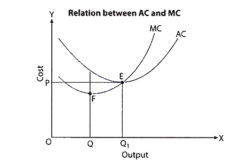
Chapter 4 Revenue and Supply
Explain the concept of Total Revenue (TR) with the help of an example.
Answer:
Total Revenue (TR):
- Money received by a firm on selling the units it produces is known as revenue. The total income received by firm from sale is called total revenue. This income is known as total revenue or sale revenue.
- A firm’s total income is based on two things:
- Price per unit and
- Total sale.
- Change in one or both the factors brings change in the revenue of the firm.
Formula:
Total Revenue (TR) = Units sold (Q) × Price of commodity (P)
Example:
A firm produces pen.
Sale price per unit of pen = ₹ 50
Total sale = 100 units
Therefore, Total Revenue (TR) = Units sold (Q) × Price of commodity (P)
TR = Q × P
∴ 5000 = 100 × 50
= ₹ 5000
∴ Firm’s Total Revenue (TR) = ₹ 5000
The firm’s total revenue will change if:
- The sale of commodity increases/decreases OR
- Price increases/decreases OR
- Both the above factors change
Question 16.
Explain the concept of Average Revenue with the help of an example.
Answer:
Average Revenue (AR):
The revenue generated per unit of output sold is called the Average Revenue (AR). It is obtained by dividing Total Revenue with Total sale.
Formula:
Average Revenue (AR) =
Example:
A firm produces pen.
Total sales (Q) = 1000 units of pen
Total revenue = ₹ 50000
∴ Average Revenue (AR) =
=
= ₹ 50
- Thus, the firm’s average revenue per pen is ₹ 50.
- The curve formed on plotting units sold against revenue is called the Average Revenue curve.
- When the firm sells all units of commodity at a same price, then Average Revenue is equal to price i.e. AR = R
- In such situation, the Average Revenue curve also becomes the demand curve for the producer.
- Demand curve shows, how much commodity is a consumer ready to purchase at different prices. On the other hand the Average Revenue-curve shows the Average Revenue of a producer by selling the commodities.
Question 17.
Explain the concept of Marginal Revenue with the help of an example.
Answer:
Marginal Revenue:
The change in total revenue which results from the sale of one more unit of a commodity is called the marginal revenue.
Formula:
MRn = Rn – R(n – 1)
where, MR = Marginal Revenue
n = Number of sold units
Rn = Revenue from the sale of n units commodity
R(n – 1) = Revenue from sale of (n – 1) units
Example:
- A firm receives income of ₹ 50,000 by selling 1000 units of pen.
- On selling 1001 units of pen, firm’s revenue increases to ₹ 50,045. Here,
n =1001,
Rn = ₹ 50,045
(n – 1) = 1000,
R(n – 1) = ₹ 50,045
Thus, Marginal Revenue MRn = Rn – R(n – 1)
= ₹ 50,045 – ₹ 50,000
= ₹ 45
Thus, the firm’s Marginal Revenue (MR) is ₹ 45.
Question 18.
State and define the types of revenue.
Answer:
Types of revenue:
1. Total Revenue (TR):
Money received by a firm on selling the units it produces is known as revenue. The total income received by firm from sale is called total revenue. This income is known as total revenue or sale revenue.
Formula:
Total Revenue (TR) = Units sold (Q) × Price of commodity (P)
2. Average Revenue (AR):
The revenue generated per unit of output sold is called the Average Revenue (AR). It is obtained by dividing total revenue with total sale.
Formula:
Average Revenue (AR) =
3. Marginal Revenue:
The change in total revenue which results from the sale of one more unit of a commodity is called the marginal revenue.
Formula:
MRn = Rn – R(n – 1)
where, MR = Marginal Revenue
n = Number of sold units
Rn = Revenue from the sale of n units commodity
R(n – 1) = Revenue from the sale of (n – 1) units
Question 19.
State the characteristics of perfect competitive market.
Answer:
Perfect competitive market:
1. Perfect market or perfect competitive market is defined by several characteristics.
Some are:
- Perfectly competitive market is such a market where firms accepts market price and sell their commodities
- Commodities are homogeneous (i.e. the qualities and characteristics of goods or services available in market do not vary between different suppliers)
- There are large number of buyers and sellers
- Buyers and sellers have complete knowledge of market situation
- Price is determined by demand and supply of a commodity. Firms sells commodity on this price only and no firm can influence this price. Hence, price is fixed and constant.

Comments
Post a Comment