Human Capital Formation
Human capital refers to the stock of skill, ability, expertise, education and knowledge in a nation at a point of time.
• Physical capital refers to assets which themselves have been manufactured and are used for production of other goods and services.
• Human capital formation is the process of adding to the stock of human capital over a period of time.
• Sources of human capital formation:
Expenditure on education
An educated man earn higher income. He enjoys good social status
•An educated man contributes more to production process. His efficiency and productivity are high.
•Educated people contributes towards the development of Science and Technology.
•Educated and skilled workers can easily adopt modern technology.
•They possess good human values and work culture.
•They have better knowledge about investment opportunities. They may become entrepreneurs.
Expenditure on health
A healthy person will be regular to his works. He will not take much leave from work.
•Efficiency and productivity in work will be more if a person is healthy.
•A healthy person can be creative. He will think about positive changes in his work.
•A healthy person earns higher income and leads a good standard of living.
•An unhealthy person is a burden to the society. Society needs to spend a lot of money on him.
•Preventive medicines such as vaccination will keep the society healthy.
•Health awareness and supply of safe drinking water
On the job training
Organisations should provide on the job training to their employees in order to keep them updated.
•The firm itself can give training to its employees.
•The workers can be send outside also for training.
Migration
People migrate in search of jobs and other economic opportunities.
•There is large scale migration from rural to urban areas. Technically qualified people migrate to other countries.
•People earn higher income in the migrated lands.
•They make additions to the Human Capital of the migrated land.
•So, expenditure on migration is also a source of Human Capital Formation.
Expenditure on information
Information about labour market and educational institutions is necessary to take decisions regarding investment in human capital and also for the better utilisation of available human capital. So, money spent on information is also a source of human capital formation.
Contribution of Human Capital Formation to Economic Growth
( (i) Increase in GDP
(ii) Effective use of capital
(iii) Invention and Innovation
(iv) Life Expectancy
(v) Improves quality of life
(Vi) Control of population
Problems facing human capital formation:
Rising population
High regional and gender inequality
Brain drain
Insufficient man power planning
Insufficient on the job training in agriculture
High poverty levels
Low academic standards.
Education Still a Challenging Proposition
Education system of the country which along with the following facts makes education still challenging proposition in India.
Large Number of Illiterates
- Inadequate vocationalisation
- Gender bias
- Low rural access level
- Privatisation
- Low government expenditure on education
Right to Education (RTE)
In the year 2012, the Government of India has brought about an Act, called RTE. It promises education to all. It makes education a matter of right to all children in the age group of 6-14 years.
Recently, Government of India has started levying a 2% ‘education cess’ on all Union taxes. The revenues from education cess has been earmarked for spending on elementary education.
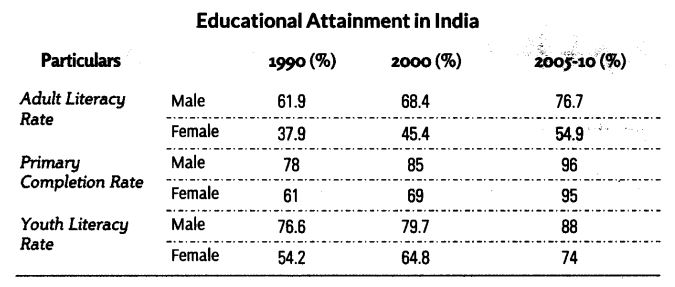
Educational Achievements in India Generally, educational achievements in a country are indicated in terms of
- Adult literacy level
- Primary education completion rate
- Youth literacy rate These statistics for the years 1990 to 2010 are given in the following table
Future Prospects
India government considers education a key sector where considerable growth and.development is required. Thus, it has set some future prospects for framing its policies.
These prospects are discussed below
Education for All : Still a Distant Dream
Although the education level in India has risen for both adults as well as for youth. Still the number of illiterates in India are as much as the population was at the time of Independence.
In 1950, when the Constitution of India was passed by the constituent assembly, it was noted in the directive principles of the constitution that the government should provide free and compulsory education for all children up to the age of 14 years within 10 years from the commencement of the constitution.
The following factors makes education still a distant dream
- Large number of illiterates
- Inadequate vocationalisation
- Gender bias
- Low rural access level
- Privatisation
- Low government expenditure on education
Gender Equity : Better than Before
The differences in literacy rates between males and females are narrowing, signifying a positive development in gender equity; still the need to promote education for women in India is imminent for various reasons, such as
- Improving economic independence.
- Social status of women.
- Healthcare of women and children.

Comments
Post a Comment