PRESENTATION OF DATA
There are generally three forms of presentation of data:
Textual or Descriptive presentation: In textual presentation, data are described within the text.
- Example 1: The workers union called for a nationwide strike on November 23, 2017, protesting the unjust laws passed during the winter session of the Parliament. In Kerala, 13 factories were closed, and two were found open. Even the schools supported the strike of the workers in the town. Out of 7 schools, five were found to be shut on the day of the protest.
- Example 2: According to the 2011 Census of India, the country’s population is 130 billion, out of which 57 crores were females and 73 crores were men. 71% of the population lived in rural areas, and 19% lived in cities. There were 84 crores quick lurkers in the entire country, against 46 crores workers.
Tabular presentation: In a tabular presentation, data are presented in rows (read horizontally) and columns (read vertically).
For example, given below is a 3 x 3 table presenting information about the literacy rates in Indian
Literacy in India by sex and location (per cent)
Sex Location
Rural Urban Total
Male 79 90 82
Female 59 80 65
Total 68 84 74
Source: Census of India 2011
Classification used in tabulation is of four kinds: –
• Qualitative - When classification is done according to attributes, such as social status, physical status, nationality, etc., it is called qualitative classification.

• Quantitative - In quantitative classification, the data are classified on the basis of characteristics which are quantitative in nature, age, height, production, income, etc are quantitative characteristics.

• Temporal - In Temporal classification time becomes the classifying variable and data are categorized according to time. Time may be in hours, days, weeks, months, years, etc.

• Spatial - When classification is done on the basis of place, it is called spatial classification. The place may be a village/town, block, district, state, country, etc.

TABULATION OF DATA AND PARTS OF A TABLE
A good table should essentially have the following components:-
(i) Table number - A table should always be numbered for identification and reference in the future. A table must be numbered 1, 2, 3 etc.
(ii) Title - There must be a title on the top of the table. The title must be appealing and attractive. A good title must contain – the topic of study, the time period of study, place of study and criteria of classification of data
(iii) Captions or Column Headings - It is the title given to the columns of a table.
A caption refers to information contained in the column of the table.
It may have sub-heads when information is divided in more than one category
For example – employees may have male and female as sub-heads
(iv)Stubs or Row Headings - Stubs are headings of horizontal rows.
These titles indicate information contained in the row of the table.
Each row in the table should be given a heading
It indicates numerical data from top to bottom in columns and from left to right in rows.
Each item in the body is called cell.
(vi) Unit of Measurement
(vii)Source - When tables are using secondary data, source of the data must be given.
(viii) Note

DIAGRAMMATIC PRESENTATION OF DATA
This is the third method of presenting data. There are various kinds of diagrams in common use. Amongst them the important ones are the following:
(i) Geometric diagram
Bar diagram
Bar diagrams are rectangular and placed on the same base. Their heights represent the magnitude/value of the variable. The width of all the bars and the gaps between the two bars are kept the same.
The following are the types of one-dimensional diagram.
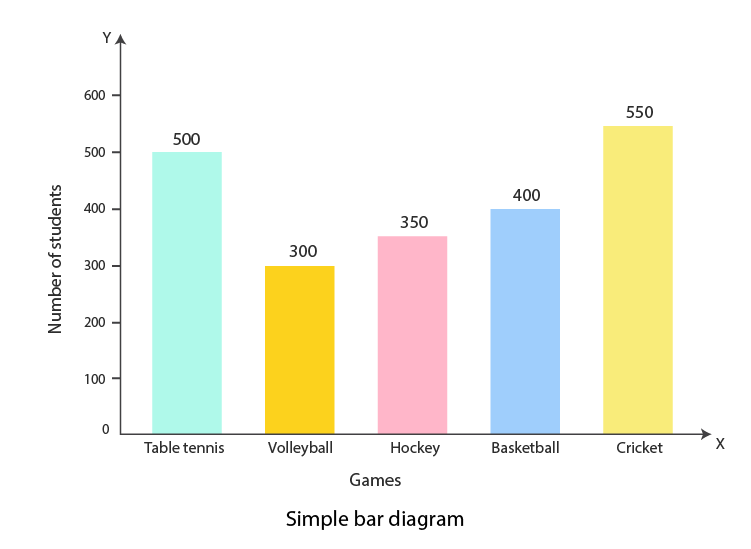
(1) Simple bar diagram
Simple bar diagram consists of a group of rectangular bars of equal width for each class or category of data.
Question - The following table shows the interest of students in a school in different games.
Solution
(2) Multiple bar diagram
This diagram is used when we have to make a comparison between two or more variables like income and expenditure, import and export for different years, marks obtained in different subjects in different classes, etc.
Faculty Number of Students 2014-15 2015-16 2016-17 Arts
Science
Commerce 600
400
200 550
500
250 500
600
300
| Faculty | Number of Students | ||
| 2014-15 | 2015-16 | 2016-17 | |
| Arts Science Commerce | 600 400 200 | 550 500 250 | 500 600 300 |

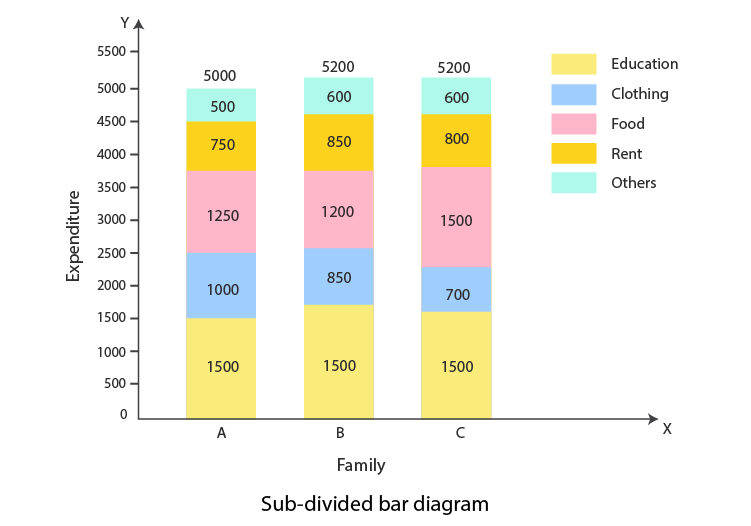
(3) Subdivided bar diagram
This diagram is constructed by subdividing the bars in the ratio of various components.
Question
The following table shows the monthly expenditure of different families on different items.
Represent the data in the form of a sub-divided bar diagram.
Solution
Following are the data about the market share of four brands of TV sets sold in Panipat and Ambala. Present the data in the pie chart.
Solution Total sets sold in Place A and Place B are 1,200 and 1,875 respectively. Data are to be represented by two circles whose radii are in the ratio of square roots of total TV sets sold in each city in the ratio of 1:1. The calculations regarding the construction of the pie diagram are as follows.

(ii) Frequency diagram - Frequency diagrams are a diagrammatic or graphical representation of data, enabling a quick and clear understanding of complex data sets. Frequency diagrams are created to avoid mistakes and provide a bird’s eye view of large data sets. The large data sets are first grouped under various frequencies and then diagrammatically represented on a paper. Besides giving an accurate picture of data, the frequency diagrams reflect a definite pattern.
The advantages of frequency diagrams are:
- It simplifies complex data sets.
- Helps represent data using appropriate diagrams.
- Saves time.
- Makes data more meaningful.
- Helps in planning, extrapolating, interpolating, and decision making with the given data.
Types of Frequency Diagrams


Present the following information in the form of a Histogram:
Present the following information in the form of a Histogram:
Wages | Number of Workers |
|---|---|
10-15 | 14 |
15-20 | 20 |
20-25 | 54 |
25-30 | 30 |
30-40 | 24 |
40-60 | 24 |
60-80 | 16 |
Solution
1. It can be seen clearly that the given class interval is unequal. So, before plotting the histogram, frequencies have to be adjusted.
2. Determine the class of the smallest interval, i.e., 10-15. Thus, the lowest class interval in the given frequency distribution is 5.
3. Formulate the Adjusted Table as shown below:
Wages | Number of Workers | Adjustment Factor | Frequency Density |
|---|---|---|---|
10-15 | 14 | 5 ÷ 5 = 1 | 14 ÷ 1 = 14 |
15-20 | 20 | 5 ÷ 5 = 1 | 20 ÷ 1 = 20 |
20-25 | 54 | 5 ÷ 5 = 1 | 54 ÷ 1 = 54 |
25-30 | 30 | 5 ÷ 5 = 1 | 30 ÷ 1 = 30 |
30-40 | 24 | 10 ÷ 5 = 2 | 24 ÷ 2 = 12 |
40-60 | 24 | 20 ÷ 5 = 4 | 24 ÷ 4 = 6 |
60-80 | 16 | 20 ÷ 5 = 4 | 16 ÷ 4 = 4 |
Ogive – Ogive is also known as cumulative frequency curve. Since there are two categories of cumulative frequencies – “less than” and “more than,” ogives for any grouped frequency data are also drawn in two types. While for the ‘less than’ ogives, the cumulative frequencies are plotted against upper limits of the class interval, for ‘more than’ ogives, they are plotted against the lower limits of class intervals. The shape of ‘less than’ ogive rises upward, whereas the shape of ‘more than’ ogive falls downwards. Interestingly, the intersection point of two ogives gives the median. Draw the ‘less than’ and ‘more than’ ogives on the same graph paper from the given data:
Solution
(i) ‘Less than’ method
(ii) ‘More than’ method
Both ‘less than’ and ‘more than’ ogives based on the above data are presented in the following graph.

Frequency Polygon
A frequency polygon is a plane bounded by straight lines, usually four or more lines. Frequency polygon is an alternative to histogram and is also derived from histogram itself.
A Make a frequency curve of the following data:
Solution
The given data set is first converted into a histogram. The mid-points are marked on the top of the rectangles of the histogram. These points are joined through a freehand smoothed curve as shown in the figure

Frequency Curve
The frequency curve is obtained by drawing a smooth freehand curve passing through the points of the frequency polygon as closely as possible. It may not necessarily pass through all the points of the frequency polygon but it passes through them as closely as possible
Draw a frequency curve for the following distribution.
Class-interval0−1010−2020−3030−4040−5050−60Frequency41015182016
The frequency distribution is continuous with equal class-intervals. We will first prepare a histogram and then the frequency curve. The class-intervals are shown along the X-axis and frequency on the Y-axis.

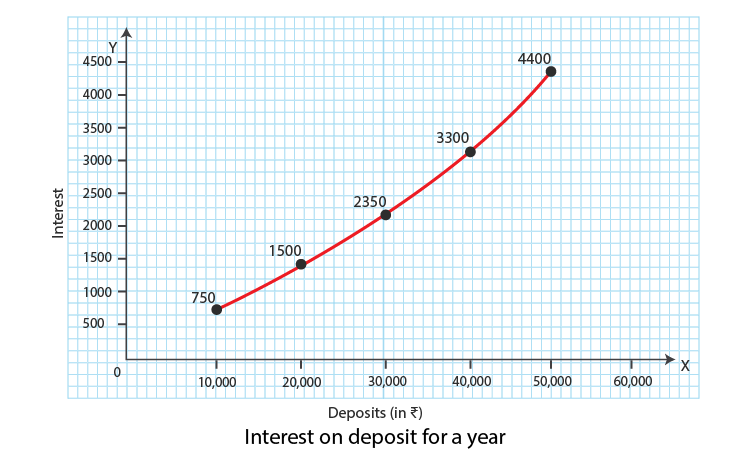
(iii) Arithmetic line graph - An arithmetic line graph is also called time series graph. In this graph, time (hour, day/date, week, month, year, etc.) is plotted along x-axis and the value of the variable (time series data) along y-axis. A line graph by joining these plotted points, thus, obtained is called arithmetic line graph (time series graph). It helps in understanding the trend, periodicity, etc., in a long term time series data.
Draw the graph of interest on deposit for a year.
Solution

Comments
Post a Comment